
How pre-registrations, registered reports and well written research proposals improve your research
Over the last two decades, the scientific community has grappled with a reproducibility crisis: many published findings don't replicate. Unfortunately, the academic publish-or-perish system creates perverse incentives. When career advancement and research funding depend on positive results and journals are unlikely to publish papers with null findings, researchers face pressure to find significance, even when it's not there. Pre-registration and registered reports have emerged as powerful countermeasures to these incentives. But more fundamentally, they represent something simpler: planning your research carefully before you begin.
Questionable Research Practices
Questionable research practices (QRPs) are non-transparent and unethical behaviors that can threaten scientific integrity. Unfortunately they are more common than we think. For example, in psychological sciences, up to 35% of researchers indicated that they had doubts about the integrity of their own research on at least one occasion (John et al., 2012). HARKing (hypothesizing after results are known), and p-hacking (trying out several statistical analyses or data eligibility specifications and then selectively reporting only those that produce significant results) are two of the more common QRPs. P-hacking can result from a variety of practices including termination of data collection once significant results are reached, stopping data exploration if an analysis reaches significance, or recording many response variables and reporting only those with significant results (Head et al., 2015). These are issues primarily because of the fact that they arise AFTER hypotheses and experiments have been developed, voiding the temporal structure of scientific reasoning. Pre-registration addresses these practices by creating a time-stamped record of your research plan before you see your data. Registered reports go one step further: journals provide in-principle acceptance based on your methodology and research question, guaranteeing publication regardless of whether you find the effect you predicted.
The numbers tell a sad story. In non-preregistered psychology research, approximately 96% of studies report positive results, while in registered reports, where peer review occurs before data collection, only 44% report positive results (Scheel et al., 2021). This isn't because pre-registration makes research less successful. It's because 1) pre-registration prevents researchers from unconsciously (or consciously) manipulating their analyses to find significance, and 2) journals have already committed to publishing the research despite what the findings are.
Pre-Registration vs. Registered Reports: What's the Difference?
Pre-registration means documenting your research plan in a public repository before beginning data collection. You receive a time-stamped DOI that you can reference in your final paper and provide to your reviewers, making it transparent which analyses were confirmatory (planned) and which were exploratory (discovered after seeing the data). But, remember! As Brian Nosek puts it, "preregistration is a plan, not a prison" (Nosek et al., 2019). Deviations from your plan are normal, as long as you report them transparently.
Registered reports take this further by adding peer review. You submit your introduction, hypotheses, and methods to a journal before collecting data (Stage 1). If reviewers approve your research plan, you receive in-principle acceptance, a commitment to publish your work regardless of the results, provided you follow your registered protocol. After completing the study, you submit the full manuscript (Stage 2), where reviewers verify that you adhered to your plan and drew appropriate conclusions.
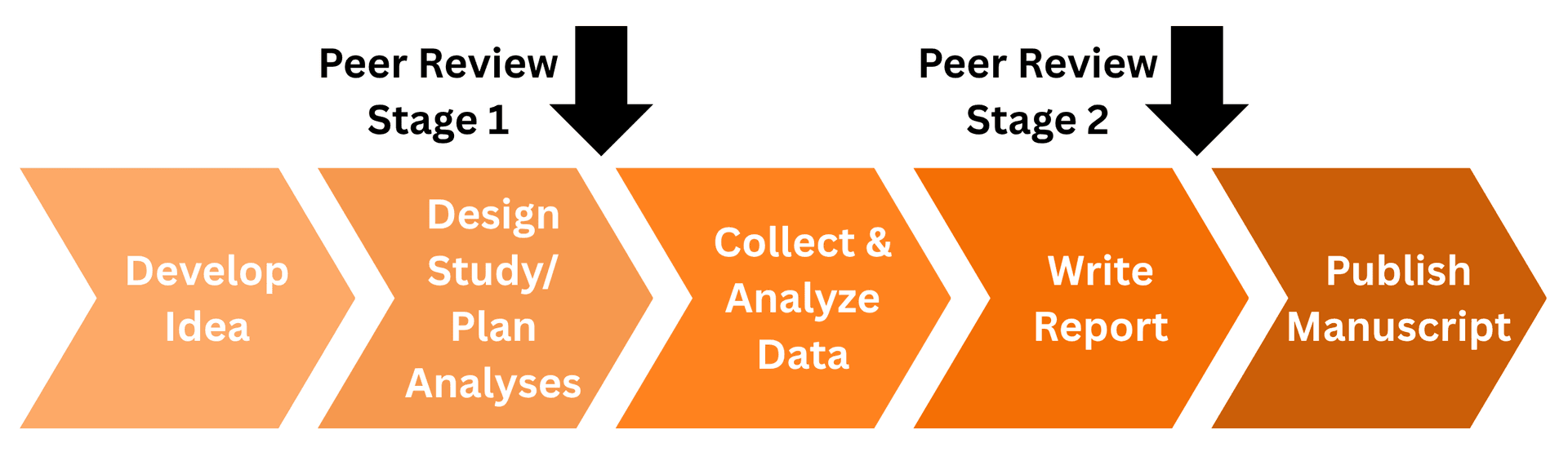 Registered Reports Process - Reproduced from the Centre for Open Science.
While this format originated in psychology, it has now spread across disciplines including neuroscience, chemistry, education, and computer science. Over 300 journals now offer registered reports, with the number steadily increasing every year (Chambers et al., 2021). One non-profit platform, the Peer Community In, enables researchers to provide peer review of Registered Reports (RR). Manuscripts that receive positive recommendations can then be published in any of the 91 PCI-RR-friendly journals without additional peer review, offering a community-driven pathway to publication.
The benefits of these formats extend beyond preventing misconduct; they can also improve study design. Writing out your hypotheses, defining variables precisely, and specifying analyses forces you to think critically about your approach when design changes are still implementable.
What Makes a Strong Research Proposal?
To get the most comprehensive feedback on your research proposal, pre-registration, or registered report, we recommend addressing the points listed in the table below. You can download it as a detailed Research Proposal template here.
| What? | Key Actions |
|---|---|
| 1. Clarify the question |
|
| 2. Contextualize |
|
| 3. Objectives and hypotheses |
|
| 4. Design |
|
| 5. Participants / Data sources |
|
| 6. Variables / Constructs |
|
| 7. Analysis plan |
|
| 8. Power / Saturation |
|
| 9. Ethical and legal considerations |
|
| 10. Data management and sharing |
|
You can also access the Open Science Framework website for templates relevant to your specific research field here.
Pre-registration and registered reports aren't about constraining creativity; they're about being honest with yourself and your field about what you planned to test versus what you discovered along the way. Both types of findings are valuable, but they carry different weight.
How Paper-Wizard Supports Better Research Planning
Whether you're preparing a pre-registration, registered report, research proposal, or grant proposal, the challenge is the same: creating a rigorous research plan with sound design and statistical analysis. This is where Paper-Wizard's Proposal & Protocol Review becomes valuable. It analyses your proposal against the standards that reviewers expect, flagging gaps in your methodology, identifying unsupported claims, and catching internal inconsistencies before you submit. Think of it as having an experienced colleague review your Stage 1 registered report or your grant proposal, except available instantly, iteratively, and at any stage of writing.
Better planning means better science. Try Paper-Wizard's Proposal & Protocol Review to identify gaps and improve your methodology before submission.
References
Chambers, C., & Tzavella, L. (2022). The past, present and future of Registered Reports. Nature Human Behaviour, 6, 29-42. https://doi.org/10.1038/s41562-021-01193-7
Head, M.L., Holman, L., Lanfear, R., Kahn, A.T., Jennions, M.D. (2015) The Extent and Consequences of P-Hacking in Science. PLOS Biology 13(3): e1002106. https://doi.org/10.1371/journal.pbio.1002106
John, L. K., Loewenstein, G., & Prelec, D. (2012). Measuring the prevalence of questionable research practices with incentives for truth telling. Psychological Science, 23(5), 524–532. https://doi.org/10.1177/0956797611430953
Nosek, B. A., Beck, E. D., Campbell, L., Flake, J. K., Hardwicke, T. E., Mellor, D. T., van ’t Veer, A. E., & Vazire, S. (2019). Preregistration Is Hard, And Worthwhile. Trends in Cognitive Sciences, 23(10), 815–818. https://doi.org/10.1016/j.tics.2019.07.009
Scheel, A. M., Schijen, M. R. M. J., & Lakens, D. (2021). An excess of positive results: Comparing the standard Psychology literature with Registered Reports. Advances in Methods and Practices in Psychological Science, 4(2). https://doi.org/10.1177/25152459211007467